

Willie Cole's "Ameriquiz"
At first glance, it looks like a test that went badly. A giant F sits on the page, and red ink runs across nearly every line, the kind of markup that makes your stomach drop before you’ve read a single comment.
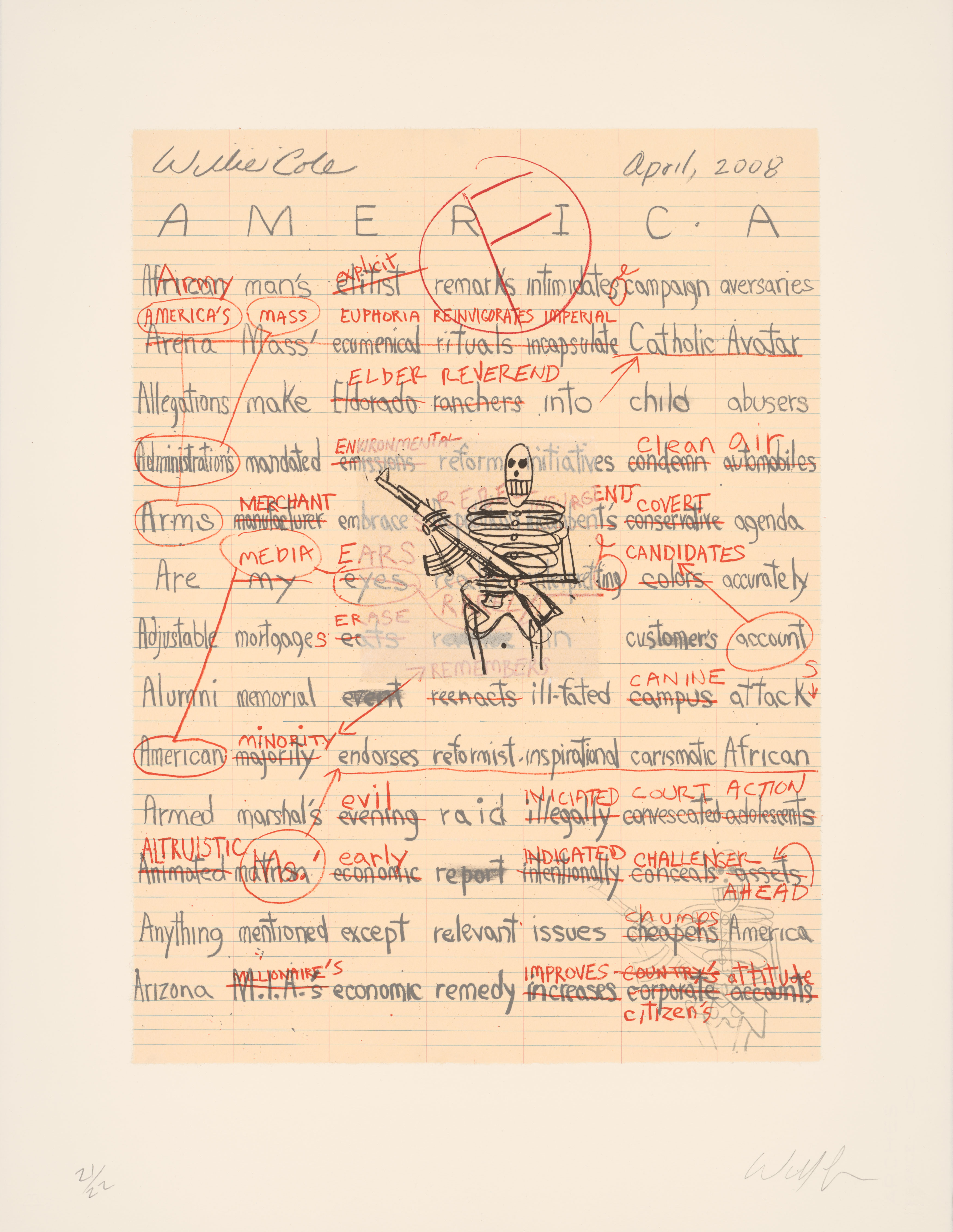
Willie Cole, Ameriquiz, 2008, six-color lithograph with chin collé
Once I slowed down, I could see what the red was marking. Cole built this print from the headlines of April 2008, a month that brought a heated presidential campaign, a papal visit, a raid on a religious community's ranch in Eldorado, Texas, and a collapsing mortgage market that took families' homes with it. Each line on the page translates one of those stories into visual form. Then Cole graded them.
His red "corrections" rewrite each headline from an opposing point of view. "African man" becomes "Army man." A campaign remark that critics called elitist is rewritten to say out loud what they claimed was only implied. The result is a quiz already taken and already marked, a failed report card for an entire nation. The title of the work, Ameriquiz, frames America as a pop quiz, as though there were only one right way to see the country and every other view deserved a red mark.
The shift from "African man" to "Army man" stands out to me because it replaces a man's heritage with a role defined by force. In the middle of all the words and corrections stands an armed skeleton, the only figure on the page that is not making an argument. Everything around it is debate: headlines, rewrites, opinions pushing against opinions. The skeleton just stands there holding a weapon. The skeleton is one of the oldest images in art. European painters placed skulls in still lifes to remind wealthy viewers that their possessions would not save them from death. In Mexican tradition, calaveras dress up and celebrate, reminding the living that death is part of life. Across many cultures, the skeleton tells us: memento mori, remember you must die. Cole's skeleton is different because it is armed. A skeleton alone reminds us that we will die. A skeleton with a weapon suggests that someone will cause it. Death becomes the result of force rather than a natural cause.
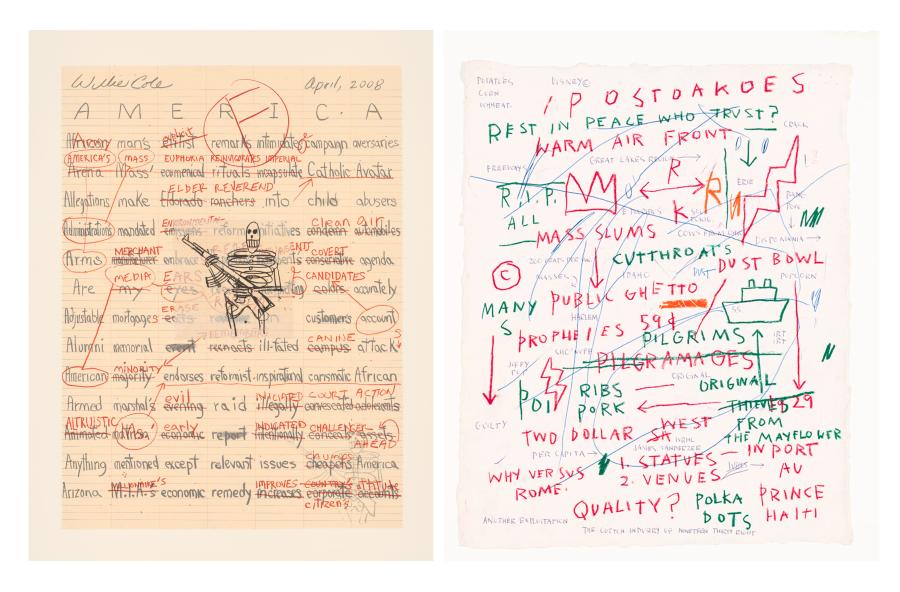
Willie Cole, Ameriquiz, 2008; Collection of the Martin Museum of Art- Baylor University; Museum purchase; Image rights courtesy of the Artist, used by permission
Jean Michel Basquiat, Untitled, 1982; Collection of the Whitney Museum of American Art; Museum purchase, with funds from Mrs. William A. Marsteller, The Norman and Rosita Winston Foundation, Inc. and the Drawing Committee; ©The Estate of Jean-Michel Basquiat. Licensed by Artestar, New York
In April 2008, armed officers entered the Eldorado ranch and removed hundreds of children. American soldiers were deployed in Iraq and Afghanistan. Families across the country were losing their homes to foreclosure, packing up kitchens and bedrooms they thought they would grow old in. I see the skeleton as the red pen’s final mark. When every disagreement gets marked wrong, force begins to feel like the only correction left.
I still do not know who the skeleton is aiming at, whether it is attacking or defending, or whether it represents the government, the public, or both. I think Cole leaves that open on purpose. The skeleton belongs to whoever is looking at it.
In 1982, Jean-Michel Basquiat made an untitled drawing, now in the Whitney’s collection, that reads like an alternate ledger of American history: “Cotton Industry of Nineteen Thirty Eight,” “Dust Bowl,” “Mass Slums,” “Public Ghetto,” “Another Exploitation.” Basquiat once said he crossed words out so people would look at them harder, and you can see that logic on the page. “Pilgramages” is struck through beneath “Pilgrims.” “Thieves” is crossed out just above “From the Mayflower.” Cole takes that act of cross-referencing and turns it into a graded test. His red pen circles, strikes, and annotates like a teacher marking errors, so that America’s own vocabulary is being checked and found wanting. Basquiat argues with the past, while Cole grades the times he is living in.
THE ARTIST RESPONDS
"Regarding Ameriquiz, Willie explains that the work belongs to a broader practice examining language, history, education, and the processes by which knowledge is produced, authorized, and circulated. Its primary material is a blackboard, an object associated with teaching and learning that, like a page from a memo pad, bears the traces of instruction, revision, and exchange.
Drawing on real-world events and contemporary headlines, including those from April 2008, the work organizes information as a graded quiz, with red-ink corrections marking the process of evaluation. This recognizable educational format provides a structure for considering how facts are selected, revised, and presented as knowledge. By placing original statements alongside their rewritten counterparts, Willie foregrounds language’s instability and the coexistence of competing perspectives in the construction of historical narratives and public understanding.
"Ameriquiz therefore asks viewers to engage not only with its subjects, but also with the assumptions, interpretive frameworks, and forms of authority that shape how information is read and remembered."
Willie Cole, in response to questions from Dorian Henry II.
Relayed by Alaina Simone, Artist Liaison, Willie Cole Studio, October 2026.
A museum could collect only work that is beautiful, calming, and easy to agree with, but that would leave out much of what makes art valuable. Works like Ameriquiz earn their place because they keep working long after the moment that produced them. Cole made this print from the news of a single month in 2008, and it reads as if it were made this year.
For the Martin Museum, this matters. Students can learn about printmaking and about Willie Cole's long practice of transforming everyday materials and images into powerful statements about identity, history, and power in America. Most importantly, Ameriquiz asks them to notice their own reactions. Collecting it says the institution is willing to host difficult conversations, even when the reflection is uncomfortable.

Dorian Henry II is a graduate assistant at the Martin Museum of Art and an MA candidate in Museum Studies at Baylor University. In Waco, he has created exhibit displays on Heisman heritage and Hall of Fame inductees at the Texas Sports Hall of Fame and rotated the Flora Cameron Gallery at Art Center Waco. As an Alliance of HBCU Museums and Galleries Fellow, he completed placements at the Yale University Art Gallery, Winterthur Museum, and Bard Graduate Center. His thesis, HBCU Museums in the 21st Century: Identity, Access, and Economic Sustainability, examines how HBCU museums survive and thrive in the 21st century. He holds a BS in Visual Arts, magna cum laude, from the University of Arkansas at Pine Bluff.